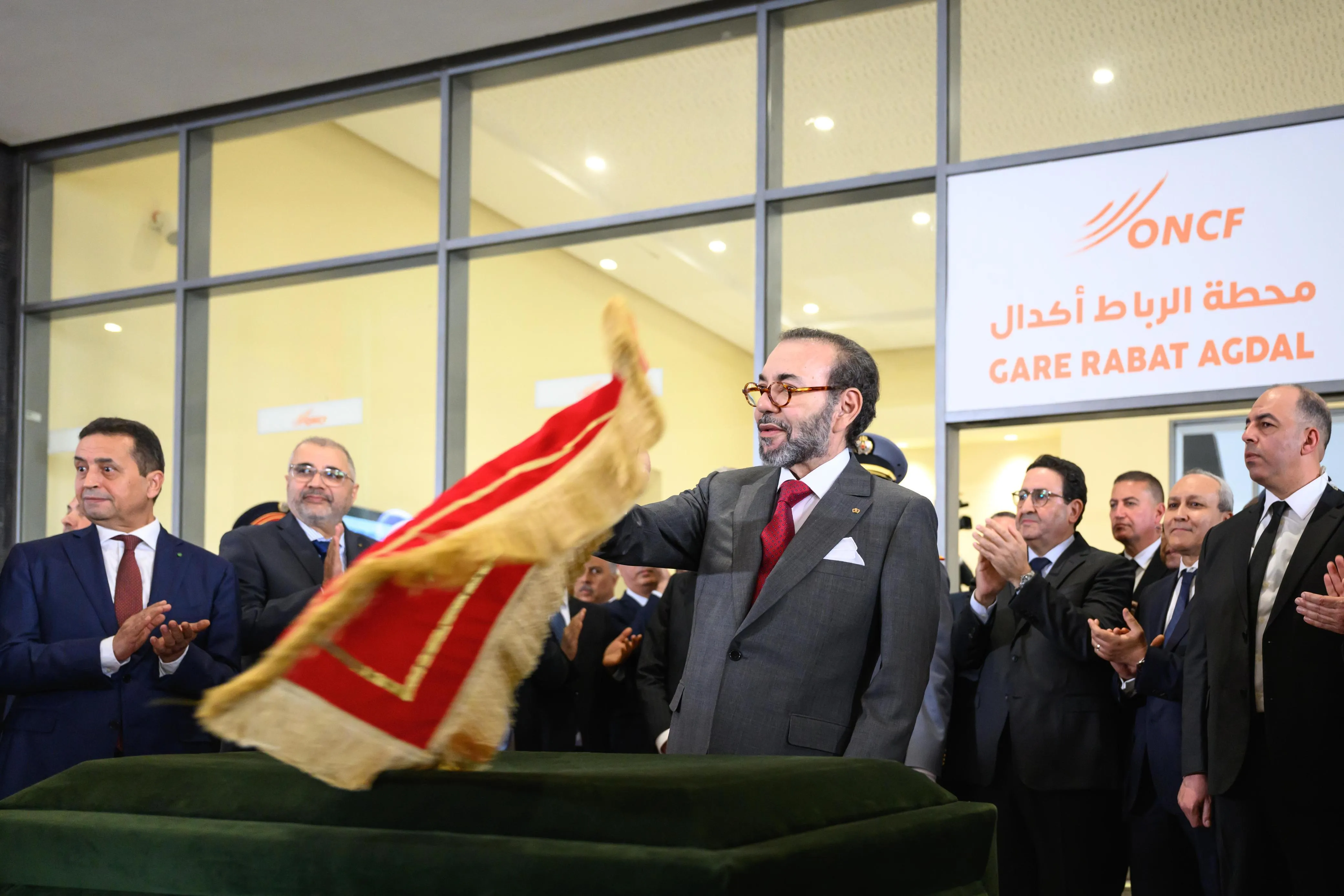
Significant Developments in Morocco's Railway Infrastructure
One year after its official launch, Morocco's national railway program, driven by King Mohammed VI, has reached a pivotal moment. With a total budget of 96 billion dirhams, this ambitious initiative aims to profoundly modernize the country's railway transport system while serving as a lever for economic competitiveness and a tool for territorial cohesion. At the center of this strategy is the future high-speed rail line connecting Kenitra and Marrakech, which alone is allocated 53 billion dirhams for infrastructure and equipment. Furthermore, the program includes the acquisition of 168 trains amounting to 29 billion dirhams, along with 14 billion dirhams dedicated to the modernization and maintenance of the existing network.
Progress and Impacts of the High-Speed Rail Project
According to the weekly magazine Challenge, the momentum on the ground is already evident. The Kenitra-Marrakech high-speed rail project, spanning 430 kilometers, is entering an advanced execution phase. The land acquisition operations, often a critical phase in major infrastructure projects, have been successfully completed within tight deadlines. "Almost all land has been cleared, allowing for optimal continuity of work along the entire route," a representative from the ONCF stated. This mastery over land acquisition has facilitated the acceleration of earthworks and construction activities, which are currently progressing steadily.
The intensity of the construction is reflected in the numbers. Nearly 20 million cubic meters of earthworks have already been executed, confirming the ramp-up of railway platform construction. "On the construction side, fifteen viaducts are currently under construction, while three strategic covered trenches (located near Casablanca Airport, Zenata, and Aïn Atiq) alone total 1.5 kilometers. Additionally, there are 92 other structures, including railway and road bridges, already underway along the entire route," Challenge highlighted.
Another significant advancement concerns the railway equipment, which is the backbone of the project. "Supplies have already reached significant levels: 2.5 million tons of ballast, 800,000 tons of sleepers, over 100,000 tons of rails, and 220 switches. These volumes indicate a large-scale industrial logistics effort mobilized to support the pace of construction and secure the upcoming phases of track laying," Challenge explained. Concurrently, laying operations have already begun on several sections of the operational network, demonstrating a gradual integration between construction and existing operations.
In terms of railway signaling, systems are entering an advanced preparation phase, with deployment planned according to a schedule aligned with safety and performance requirements for high-speed lines. With regard to passenger stations, a decisive milestone has been reached: the architectural concept is finalized. Construction is now following a staggered phasing approach, with the first phase set to launch in early 2026. All stations are expected to be engaged by July 2026, confirming a close synchronization between infrastructure and user services.
Beyond its technical dimensions, the railway program is already playing a structural role in the national economy. Nearly 150 companies are mobilized on the various lots, with about two-thirds being Moroccan. This strong involvement of the local entrepreneurial fabric confirms the project's catalytic effect on national value chains, particularly in the construction, engineering, metallurgy, and technical services sectors. "This dynamic illustrates a committed strategy for developing local skills and consolidating a Moroccan railway industrial ecosystem," it was noted.
With secured land, large-scale civil engineering works in progress, significantly supplied equipment, and finalized station architecture, all components of the program are now in active phase. Ultimately, the future high-speed rail line is part of a broader ambition: to modernize the national railway network, enhance territorial connectivity, and support the transition towards sustainable mobility. It extends a strategic vision championed at the highest levels of the State, where rail becomes a central lever for economic, social, and territorial development.
As reported by fr.le360.ma.