Unveiling Social Life Through an Ancient Game Board
A recent archaeological discovery at the medieval hammam of Walīla, the Islamic-period settlement located near the ancient Roman city of Volubilis in Morocco, has provided intriguing insights into the social dynamics and leisure activities of the early medieval Islamic world. Researchers have uncovered a stone game board that is believed to be the earliest known evidence of the game tab/sig in North Africa. This significant finding was detailed in a study published in the journal Libyan Studies by Tim Penn, Corisande Fenwick, and Hassan Limane, offering scholars a rare example of a game board securely dated to an early Islamic context, thus enriching our understanding of leisure and social interaction during this period.
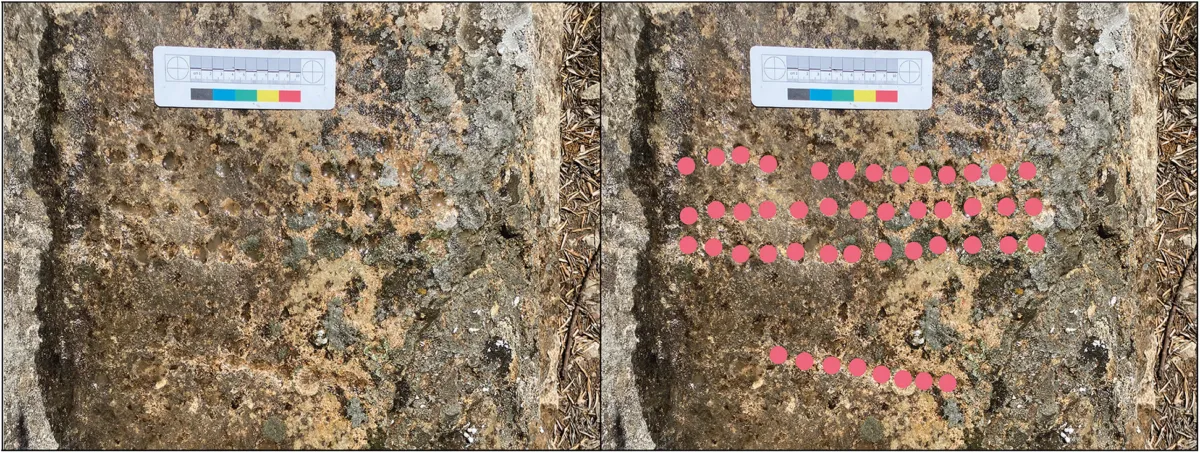
The game board was meticulously carved into the upper step leading down to the cold plunge pool of the hammam, measuring approximately 34 centimeters by 9.5 centimeters and featuring three rows of at least 13 shallow holes. An additional, irregular row may have served as a scoring mechanism or could belong to another incomplete or damaged game board. The strategic placement of the board at the entrance to the cold pool is particularly revealing, suggesting that it was designed to be visible to all bathers. This indicates that playing games was likely woven into the fabric of bathhouse life, providing a way for individuals to engage in leisure activities while waiting, resting, or conversing between bathing sessions.
The Cultural Context of Walīla and Its Hammam
The hammam itself dates back to the late eighth or early ninth century CE and was abandoned by the tenth or eleventh century, providing a clearer timeline for the game board compared to many other ancient and medieval game artifacts, which are often difficult to date accurately due to overlaps with earlier Roman or late antique periods. Volubilis, once a prominent Roman city in northern Morocco, continued to thrive in a modified form after the departure of Roman authority, ultimately becoming known as Walīla during the early medieval period. This site is historically significant as it became closely associated with the early Idrisid dynasty, particularly when Idrīs I sought refuge there after fleeing the eastern Islamic world, subsequently establishing one of the first centers of Islamic political power in North Africa.
Within this context, the hammam was part of a larger extramural complex that potentially linked to the residence of Idrīs I and his son. The architecture, heating systems, and material culture of the site suggest a community deeply connected to broader Islamic traditions, indicating interactions beyond local customs. The game board itself presents a unique typology that does not align neatly with well-known game formats. While researchers considered the possibility of it being a mancala-style game, the configuration and shallow nature of the holes point more convincingly towards tab/sig, a game that involves moving pieces across rows to capture opponents’ pieces, reflecting a dynamic form of social interaction.
This discovery not only enriches the historical narrative surrounding the game tab/sig but also reshapes our understanding of hammams as social hubs rather than mere bathing facilities. The presence of a game board carved into a step symbolizes everyday life in the medieval Islamic world, showcasing how individuals utilized their environment to foster social connections through play. It highlights a moment of shared experience among bathers, where leisure and competition were integral to communal life. The Walīla game board, while seemingly modest in appearance, holds the potential to redefine our perceptions of North African board games, pushing back the timeline of their existence and illustrating the cultural exchanges that occurred across regions.
As reported by arkeonews.net.