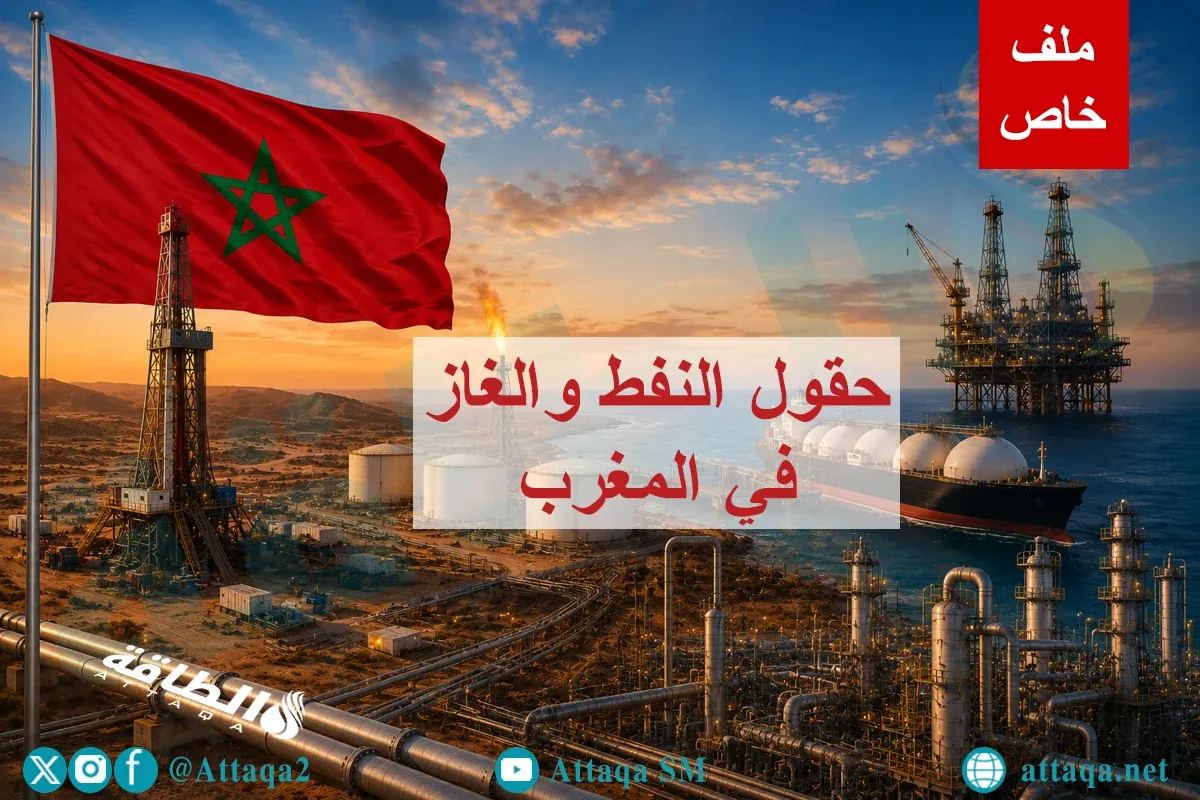
The specialized energy platform based in Washington has released a comprehensive report on the oil and gas fields in Morocco, highlighting essential information regarding reserves, production, and development plans aimed at enhancing the kingdom's energy security. This detailed dossier provides accurate data about the significant oil and gas discoveries in Morocco over recent decades, alongside the efforts made to exploit these resources and reduce reliance on imports.
Within the report, numerical data on discovered reserves in several onshore and offshore fields is presented, as well as the operational companies' plans for their development, aligning with Rabat’s ambitions to achieve self-sufficiency in natural gas in the coming years. Furthermore, the report contains extensive information about the locations of these fields, their discovery history, economic significance, and their anticipated role in supporting industrial growth and meeting the increasing energy demand within the kingdom.
Despite the promising reserves of oil and gas, development operations have yet to meet the kingdom's aspirations and previously announced plans. Currently, the country continues to depend heavily on coal for electricity generation, which accounts for 61.5% of the mix, along with a growing share of renewable energy nearing 24%, as per data from 2025.
Key Oil and Gas Fields in Morocco
The report begins by detailing the most noteworthy oil and gas fields in Morocco, including an analysis of the offshore Anchoa field, recognized as the largest gas field in the kingdom since its discovery in 2009. This field is viewed as crucial for meeting a significant portion of local energy demand, with reserves estimated at around 1.4 trillion cubic feet of natural gas, potentially providing nearly one billion cubic meters annually. However, the field's development has faced several challenges following the withdrawal of the Greek company Energean in 2025.
Another significant field discussed is the Miskala gas field, which is regarded as one of Morocco's most important gas discoveries. Located in the Essaouira basin, a promising area for natural gas and crude oil, this field is expected to boost the national economy and enhance the kingdom's position in the regional energy market. Experts believe that developing this field could represent a significant step towards increasing local production in the coming years.
The report also covers the Tendrara gas field, which holds particular importance for Morocco due to its expected role in supporting plans for self-sufficiency and reducing reliance on fuel imports. The field is anticipated to meet part of the local demand for natural gas, especially since Morocco consumes about one billion cubic meters annually for electricity generation and various industries. Furthermore, it includes a liquefied natural gas project aimed at transporting fuel to remote areas within the kingdom.
In addition to these fields, the report discusses the Anoual gas field, where exploration activities are ongoing in preparation for the commencement of commercial production. This initiative is part of Rabat's efforts to diversify its energy sources and enhance supply security. Operated by the British company Sound Energy with a 75% stake, while the Moroccan National Office of Hydrocarbons and Mines holds the remaining 25%, this project is expected to contribute to local gas production in the coming years.
Production of Oil and Gas in Morocco
The specialized energy platform has closely monitored the efforts to develop natural gas production from several promising projects, including the Ghrissif gas field, which represents an essential initiative for securing the kingdom's energy needs. This field is particularly significant due to the discoveries linked to it, especially helium gas reserves. Morocco is eagerly anticipating the commencement of production from major fields such as Anchoa, Tendrara, and Ghrissif, which are crucial for reducing imports and increasing reliance on domestic production.
The report also sheds light on the Lagzira oil field, previously known as the Sidi Moussa field, discovered in 2012. Foreign companies announced the presence of substantial reserves of crude oil and natural gas along Morocco's western coast. Some studies estimated the reserves at approximately 6.1 billion barrels of crude oil, alongside significant quantities of natural gas, making it one of the most promising oil projects that have attracted attention to the kingdom's hydrocarbon potential.
Simultaneously, the report highlights the Tarfa oil field, which possesses vast reserves of shale oil estimated at around 22 billion barrels, making it one of the largest untapped oil resources in the country. The Italian company Eni has announced plans to commence drilling in the area in 2023, amid expectations of discovering commercially viable quantities of crude oil. However, the project remains in early stages as Morocco continues its efforts to capitalize on its oil and gas resources and reduce its energy import bill.
As reported by attaqa.net.