
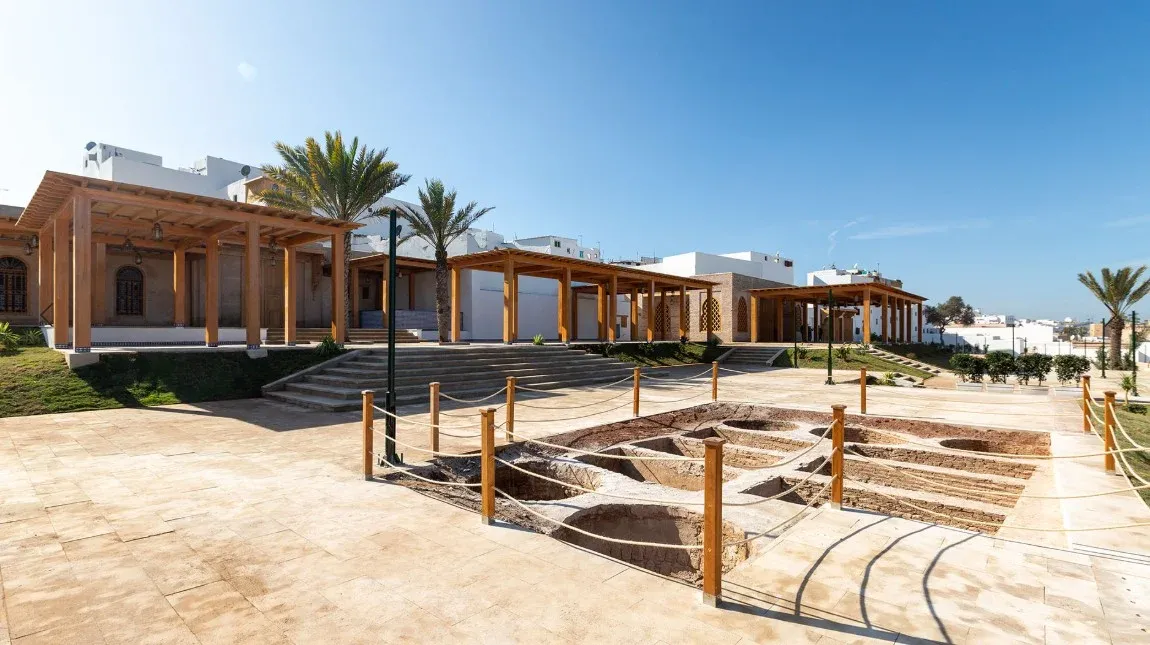
The Transformation of Diour Dbagh: A Historical Revival
The long-awaited requalification of the tanneries in Rabat has reached its completion, marking the end of nearly a century of neglect during which the site transformed from a hub of artisanal craftsmanship into a neglected area filled with makeshift dwellings and waste. Today, Diour Dbagh stands as a testament to the rich history it embodies, thanks to years of dedicated restoration work and prior archaeological assessments. This site reflects the deep-rooted significance of leatherworking in the economic fabric of the ancient imperial city, which shared its renowned craftsmanship with other cities like Fes and Marrakech, both of which boast larger tanning facilities in their historic medinas.
These cities, among others, have historically served as spiritual, artisanal, political, and intellectual capitals, earning their reputation as vital centers of traditional leather craftsmanship. They encompass all facets of this artisanal trade, from tanning operations to the production of traditional slippers, bags, tarbouches (fezzes), belts, and poufs. In Rabat, Diour Dbagh encapsulates this rich history, which reached its zenith during the reign of the Almohads (1121 – 1269). Located in the northeastern part of the medina, these tanneries overlook the confluence of the Bouregreg River.
For many years, master tanners utilized traditional manual techniques involving lime, pigeon droppings, and tannin to supply the local leather goods market. The official platform for the exploration, enhancement, and transmission of the region's historical heritage, Rabat Sites, highlights that Diour Dbagh represents a site of memory that helps sustain the traditional skills linked to Morocco's leather industry. Indeed, it has built an enviable reputation for the quality of its diverse products, to the extent that the term 'leatherworking' is still synonymous with the preparation of fine, dyed leather and its application in the manufacturing of various items, including bookbinding, shoes, and other leather goods.
A Rich Yet Underdocumented History
While the exact dating of Diour Dbagh remains uncertain, historical accounts suggest that the tanneries existed prior to the 20th century, although they are more recent than those in Fes and Marrakech, which were operational between the 9th and 11th centuries. An archaeological assessment published in 2024 in the journal Hespéris Tamuda, conducted by Ahmed Saleh Ettahiri, Asmae El Kacimi (INSAP, Rabat), and Hicham Rguig (Cadi Ayyad University, Marrakech), indicates that there is little doubt that the ancient tanneries of Rabat predate the construction of the river fortifications and Bāb al-Baḥr, which means they existed before 1204 H./1789. However, the researchers emphasize the need to address the issue of great antiquity in light of the complex and dynamic urbanization processes characteristic of Ribāṭ al-Fatḥ.
The historian Jean-Louis Miège, born in the city in 1923, compiled unpublished documents regarding the artisan trades of Rabat and Salé in the mid-19th century. His study, published in the Bulletin économique et social du Maroc (BESM), reveals that the tanneries between Rabat and Salé were involved in processing cow, goat, and sheep hides. Approximately 150 workshops specialized in slippers, and eight factories produced around 400 saddles annually.
Documentation on the tanneries of Rabat continued even after the Protectorate period (1912). At that time, the city evolved into a political and administrative center, succeeding Fes as the capital. This urban expansion was accompanied by efforts to eliminate polluting activities and unpleasant industries. According to the archaeological assessment, by the early 20th century, Diour Dbagh had lost over 50% of its tanners, with their numbers declining from 500 to around 300 between 1912 and 1918.
The challenges faced by tanners and the reasons for their decline are partly explained in the work of historian Abdelaziz El Khamlichi, titled "La ville de Rabat au XIXe siècle (1818-1912): aspects de la vie sociale et économique," which also discusses the urban development of the city. He notes the prevalence of mosques, sanctuaries, and zawyas in a city that maintained a stable population of about 25,000 residents during the 19th century. Until the Protectorate, Rabat consisted of eleven neighborhoods, in addition to the Kasbah of the Oudayas. Industrial production competed with that of Fes and Marrakech, particularly in the textile and leather sectors.
Despite its richness, this economic prosperity could not be sustained, as periods of drought exacerbated the industrial crisis, highlighting the close relationship between these activities and agricultural production. Other contributing factors to the decline included foreign monopolies over exports, heavy taxation, and donations imposed on the elite, which weakened the artisans.
The extensive writings covering a broader period indicate that the tanneries relocated to the outskirts of the city during the 1930s. Since then, the abandoned facilities became home to slums until their eviction was initiated in 2006. For decades, the area remained in a state of decay until revitalization efforts began in 2022, starting with disinfection and restoration.
The site also garnered scientific interest through the archaeological assessment, which underscored the importance of documenting the site to better understand Moroccan tanning workshops, both in their materiality and internal dynamics, and to gain knowledge about the contexts of similar structures that may be discovered in the future. Another avenue explored was the decision made in the early 1930s to relocate these tanneries after at least two and a half centuries of existence in the urban margins of residential neighborhoods, yet still within the walls of the Rabat medina. Researchers explain that this context gradually led to the emergence of slums, which formed the most marginalized area in the heart of the medina: a poor migrant population drawn by the advantages of proximity to the city center and access to affordable housing, a site excluded from pedestrian routes frequented by both locals and visitors.
In this regard, the project initiated in 2022 has put an end to a situation that contained the seeds of conflict between the historical site and its urban environment, while reinforcing its protection against various land speculations in the capital's heart. The former tanneries now feature an exhibition space and tourist enhancement initiatives, preserving a part of the memory of this traditional craftsmanship.
As reported by yabiladi.com.