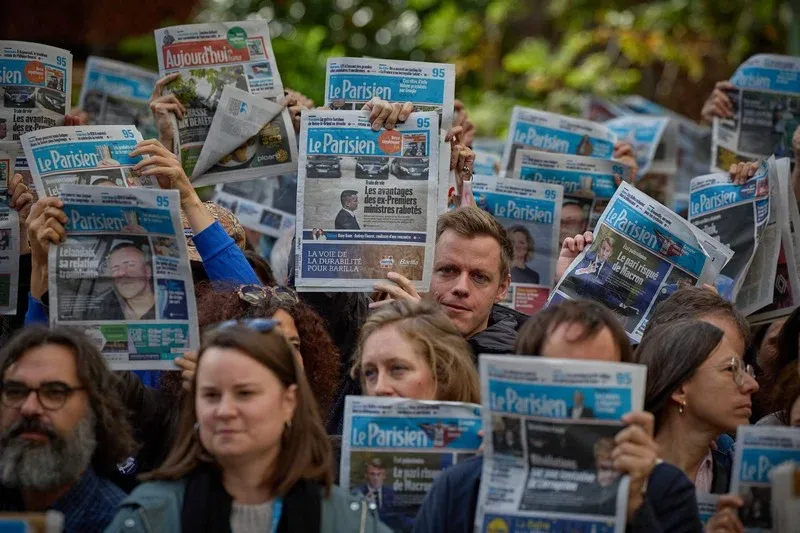
As France grapples with the aftermath of unrest following Paris Saint-Germain's second consecutive UEFA Champions League victory, where over 890 individuals were arrested and 178 police officers were injured, President Emmanuel Macron condemned what he termed 'unacceptable scenes of violence' witnessed in Paris and other French cities. Amidst this turmoil, the French newspaper "Le Parisien" opted to focus on a vastly different narrative — that of a French citizen of Algerian descent who was detained in Morocco following documented riots during the Africa Cup of Nations final. The article presented a one-sided account, seemingly reducing the entire case to the testimony of one party, neglecting a balanced representation of legal documents and evidence that are essential for an informed discussion.
No one can contest a newspaper’s right to choose its topics, as this is a fundamental aspect of journalism. Moreover, it is the prerogative of any media outlet to challenge, investigate, and pose difficult questions; journalism that shuns inquiry ceases to fulfill its purpose. However, the issue arises when questions morph into preconceived judgments, and a singular narrative suffices to construct a complete story, while other relevant facts are relegated to the periphery because they do not fit the desired narrative.
The article published by "Le Parisien" provided ample space for the account of the French-Algerian citizen, who described his arrest and interrogation conditions, positioning himself as a victim of procedures that allegedly violated his fundamental rights. Nonetheless, subsequent documents and evidence portrayed a different story, indicating that his arrest followed direct observation by a judicial police officer within the stadium and that the investigation adhered to the legal protocols in place. He was informed of his legal rights in French, and his family was notified of his detention, with legal safeguards provided to him. While anyone is entitled to discuss, question, or seek verification of these facts, it is the duty of journalism to present them to the reader, as they are part of the case. True balance does not equate to adopting a specific narrative but requires the presentation of all facts before drawing any conclusions.
Ironically, the very state to which the newspaper belongs was simultaneously facing large-scale violence within its borders at that time, executing hundreds of arrests in mere hours while security forces intervened in multiple cities. President Macron explicitly addressed the need to uphold public order and combat acts of vandalism. Yet, no one questioned whether France remained a nation governed by law, nor did the arrests become evidence of a legitimacy crisis or institutional failure. The security measures were not framed as an inherent suspicion but rather as tools employed by a state to safeguard public safety in the face of chaos.
However, the narrative shifts dramatically when the focus moves across the Mediterranean. The same law becomes a source of skepticism, and the same procedures turn into fodder for doubt, with institutions seemingly compelled to prove their innocence before examining the facts, as if law gains legitimacy when enforced in Paris and loses it when applied in Rabat. It appears as though legal texts, procedures, and guarantees alone are insufficient; they require external validation to be deemed credible.
Herein lies the crux of the issue. This case is not merely about a French citizen of Algerian descent or an article published by a French newspaper; it represents a broader perspective that remains prevalent in certain media and political circles. This perspective acts as though it possesses the authority to grant or withhold legitimacy, to distribute trust and suspicion, and to determine who enforces the law and who abuses it. It resembles a modern version of indulgences.
Although the indulgences known in medieval Europe have become a relic of history, the underlying concept has not entirely disappeared. There are still those who behave as if they are the ultimate arbiters of approval, determining who deserves acceptance and who warrants condemnation. Some outlets continue to regard themselves as the authority entitled to issue certificates of good political and legal conduct for states and peoples.
Consequently, it sometimes appears that certain media entities observe events through two different lenses: one that understands procedures when they occur within their national sphere and another that approaches the same procedures with skepticism when they take place beyond that boundary. If French police arrest hundreds, it is viewed as a defense of public order; however, if another nation detains individuals involved in rioting, the inquiry shifts from the facts to the legitimacy of the state's institutions.
This is not merely a professional error but a fundamental misunderstanding of the world. The era in which certain capitals monopolized the right to evaluate and pass judgment no longer exists in the same way. Countries that were once treated as mere arenas for observation and guidance have transformed into active players in their regional and international contexts, possessing their interests, priorities, and institutions, and making decisions based on their national calculations rather than external expectations.
Morocco is one such country. The kingdom is no longer the nation that awaits external praise to bolster its self-confidence, nor does it operate within the confines of traditional influence delineated by outdated maps. It has become a key partner in security, migration, counter-terrorism, energy, and investment issues, strengthening its presence in Africa and the Mediterranean. Morocco has emerged as an influential player in various regional matters, making it unsurprising that media attention towards the country is growing. Countries that take action create news, those that impose a regional presence spark discussions, and those that successfully expand their influence become subjects of continual observation, whether due to admiration, competition, or even dissatisfaction.
However, interest in a country does not equate to abandoning journalistic standards. Journalism does not lose its value when it criticizes; it loses its integrity when it ceases to be fair. It does not lose its credibility when it asks questions; it loses it when it pre-selects answers. What readers expect from a prominent newspaper like "Le Parisien" is not a defense of Morocco or an endorsement of the official narrative, but rather the same thorough reporting that good journalism embodies — presenting all facts and allowing the reader to make their own judgments.
To transform a single narrative into a complete truth while relegating other documents and data to mere footnotes does not serve the truth or the integrity of journalism. In conclusion, Morocco does not require new indulgences or certificates of good conduct dispensed by newspapers, power centers, or opinion circles. Nations derive their legitimacy not from editorial columns or commentators' judgments but from their institutions and their ability to safeguard their interests, enforce their laws, and maintain stability. The old ledgers that some still believe they have the right to inscribe in have changed more than they have, reflecting their authors' illusions more than the realities of the countries they seek to judge.
As reported by hespress.com.