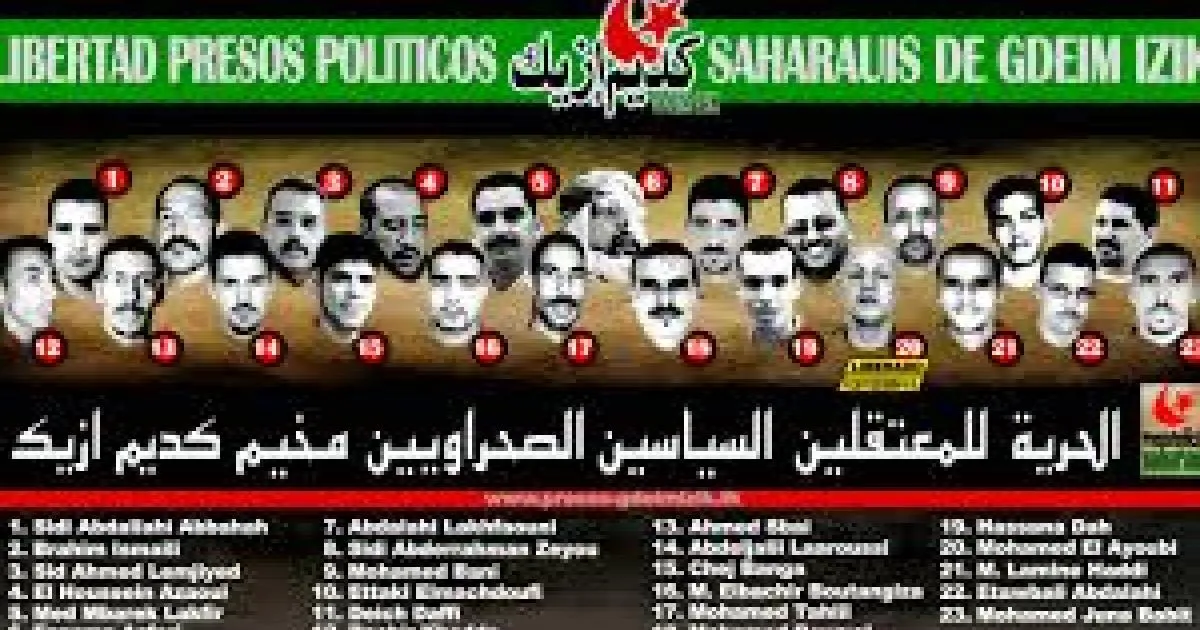
On May 26, 2026, a comprehensive joint statement was released by the League for the Protection of Sahrawi Political Prisoners in Moroccan Prisons, in collaboration with various legal professionals and international human rights organizations. The statement highlighted the recent conclusions drawn by the UN Committee Against Torture, which revealed that Moroccan authorities have employed torture and inhumane treatment against numerous Sahrawi detainees, particularly those affiliated with the Gdeim Izik group. The confessions obtained under duress were subsequently utilized as the foundation for their convictions.
The origins of this alarming situation trace back to November 2010, when Moroccan forces forcibly dismantled the Gdeim Izik camp situated near Aaiun. This aggressive action sparked fierce confrontations between Sahrawi protesters and Moroccan security forces, leading to a widespread crackdown that resulted in the arrest of numerous Sahrawi activists. These individuals were subsequently tried in a Moroccan military court, where they faced severe sentences.
The statement underscored that several detainees have endured arbitrary detention for over fifteen years under deplorable conditions. It was noted that during their interrogations, these prisoners were subjected to abduction and torture in facilities operated by the Moroccan gendarmerie and military, as well as within the confines of Salé 1 and Salé 2 prisons.
Historically, complaints lodged by Sahrawi, French, Italian, and Swiss attorneys, alongside various human rights organizations, have led to six UN decisions condemning Morocco for its torture practices. In 2022, four additional complaints were submitted, exposing clear violations of both international human rights law and humanitarian law perpetrated by Moroccan authorities.
The UN Committee Against Torture, after reviewing the evidence presented, issued decisions regarding detainees Hassan Daddah, Ahmed Sbaai, Mohamed Lamin Haddi, and Sidi Ahmed Lemjeyid, confirming that the confessions used as the basis for their convictions were obtained through torture. Furthermore, the Moroccan authorities have failed to initiate independent and effective investigations into these allegations.
The organizations that signed the statement viewed these decisions as a significant legal condemnation of Morocco, underscoring a persistent pattern of arbitrary arrests, torture, and solitary confinement of Sahrawi political prisoners. They criticized the judiciary's reliance on dubious confessions and questionable legality, emphasizing the need for reform.
Moreover, for the tenth instance in similar cases, the Committee Against Torture has brought attention to serious institutional shortcomings, particularly the failure to adhere to the Istanbul Protocol, which outlines the investigation procedures for torture allegations. This negligence persists despite the presence of physical evidence and consistent testimonies from detainees.
The authors of the statement expressed concern that the latest decisions undermine the legitimacy of the trials related to the Gdeim Izik case, especially since a portion of the proceedings occurred in a military court, despite the defendants being civilians—a situation that contradicts international fair trial standards.
Politically, the statement contends that these developments arise amidst heightened international scrutiny of the human rights landscape in Western Sahara. They reveal a significant “contradiction” between Morocco's international commitments and the actions criticized by UN mechanisms.
In conclusion, the signatories called for prompt and independent investigations into all allegations of torture, the annulment of verdicts based on disputed confessions, and the immediate release of all Gdeim Izik detainees. They demanded assurances for detainees' access to legal counsel, medical professionals, and family visits, alongside the alignment of Morocco’s judiciary and security systems with international human rights standards.
The statement concluded by asserting that the UN Committee Against Torture's decisions mark an “important legal and political turning point” in the global approach to the Gdeim Izik detainees’ situation, reaffirming the necessity of combating impunity and safeguarding fundamental rights as central tenets of contemporary international law.
As reported by spsrasd.info.