The Water Supply Crisis in Meknes
Meknes, along with several other regions in the area, is currently grappling with a troubling disruption in its drinking water supply. The sweltering heat wave has persisted for over three weeks, resulting in complete water outages or significantly reduced water flow in various neighborhoods of the city. Authorities attribute this issue to a sudden malfunction in the main water conveyance pipeline originating from the Idriss I dam. While this may initially seem like a natural and expected occurrence, such an impression conceals numerous facets of confusion and inquiry, casting doubt on the governance and management of the situation.
Several critical questions arise from this perplexing scenario:
- How can a city like Meknes, established on the abundance of greenery and water, make its water sovereignty dependent on a source nearly 100 kilometers away, especially when natural springs are present both within and at the city's periphery?
- Who is responsible for managing the water service in Meknes, from source safeguarding to production and distribution, particularly when the regional multi-service company in the Fes-Meknes region has issued multiple statements disassociating itself from the malfunction?
- What are the legal, political, and ethical responsibilities of elected officials towards the residents who voted for them?
- What responsibilities do residents and various local entities hold in the poor management trajectory of this vital service in the city?
In an attempt to address these pressing questions, we will evaluate the water management situation in Meknes through a comprehensive geographical perspective rather than solely a technical one.
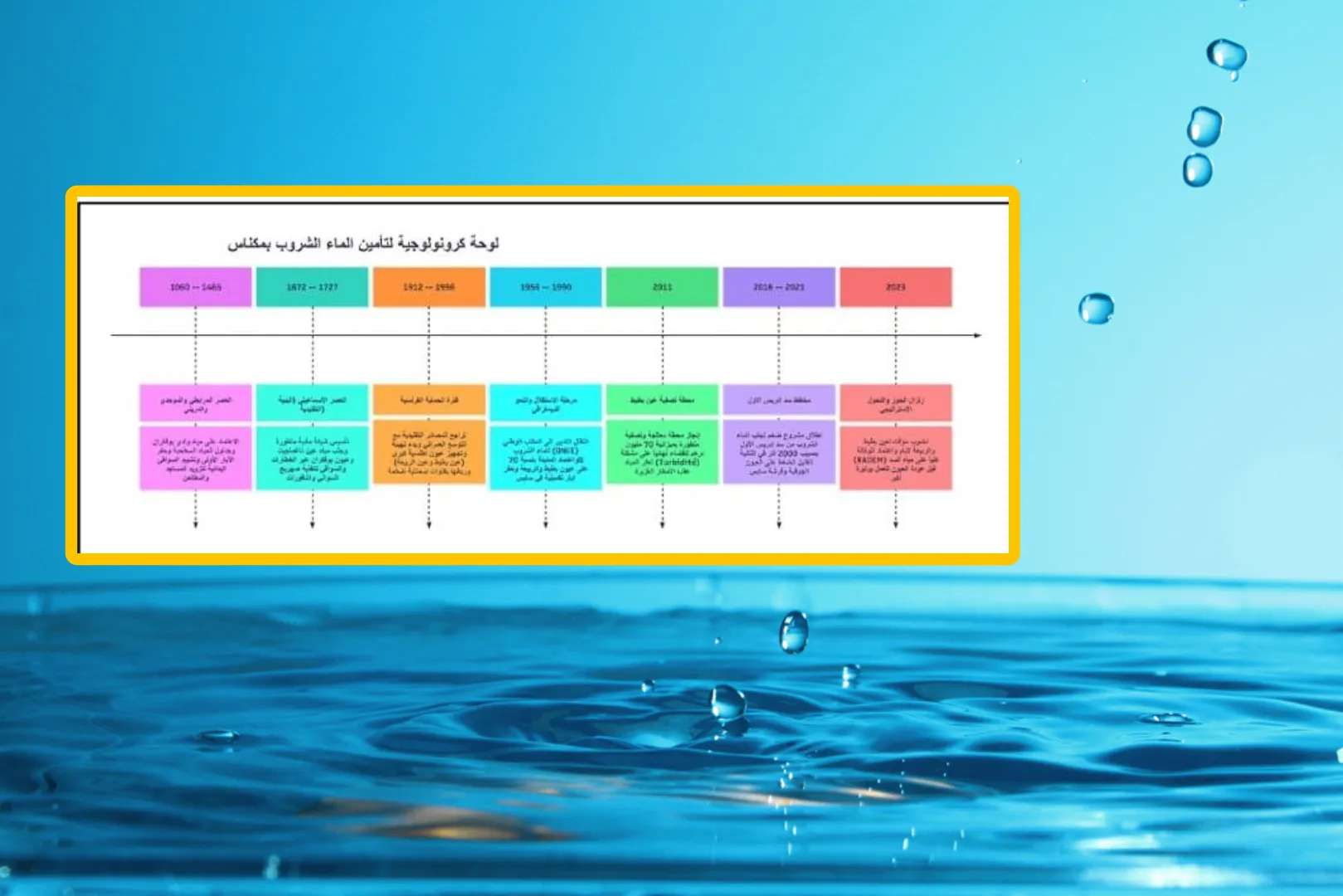
Chronology of Drinking Water Management in Meknes
Through a review of various sources concerning the water issue in Meknes, we can summarize the city's relationship with drinking water through significant historical milestones. It is evident that from its inception until 2016, which marks approximately a millennium, Meknes relied on local sources for its drinking water, such as the Boufekran river and nearby springs. The city accumulated substantial expertise in the production, storage, distribution, and strategic assurance of drinking water. However, the second decade of this century witnessed a decisive shift from local water assurance to reliance on external sources, particularly the Idriss I dam. What prompted this transformation, and what is its effectiveness?
This transition from underground to surface water in Meknes is seen as a significant risk, as surface water is the first to be affected by drought, evaporation, pollution from industrial effluents, and agricultural pesticides, alongside various threats posed by current climate changes. Additionally, water stagnation in the dam leads to a decline in quality regarding taste, color, and odor, necessitating high treatment costs and significant energy consumption for pumping and transporting water to distribution networks. Consequently, this situation inevitably impacts residents with increased service costs, where upper-tier consumers bear the brunt of price hikes reflecting the actual costs of producing dam water. In contrast, spring water undergoes natural filtration and flows topographically towards Meknes, resulting in negligible costs.
This raises the question: why was there a shift to dam water for securing Meknes’ drinking supply? When did this change occur? We believe that this change was not merely triggered by the Al Haouz earthquake, resulting tectonic movements affecting many springs, nor was it simply a consequence of ongoing drought or the looming threat of climate change. Instead, it was driven by an administrative decision that transformed the Saïss region's agriculture from subsistence to capitalist farming. The crisis reached its peak with the Green Morocco Plan, which aimed to promote export agriculture, or rather, "exporting virtual water." This plan injected over 100 billion dirhams nationwide over a decade, with the majority aimed at modernizing large farms and stimulating export production. Consequently, the proportion of large capitalist farms (exceeding 50 hectares, and sometimes reaching over 500 hectares) accounted for 35% to 40% of the total irrigated area in the Saïss plateau, while irrigated areas via underground water increased to over 60,000 hectares due to this support. The result was a drop in groundwater levels in the Sebou Basin (to which the Saïss plateau belongs) by minus 3 meters and a decline of 2.5 meters in the Fes-Meknes layer. Regarding the Boufekran spring, its average flow has reportedly dropped by 21%, according to the Ministry of Equipment and Water (July 9, 2024).
Who is primarily responsible for this decline in the Saïss aquifers?
In addition to the poorly strategized and ill-considered decision to support export agriculture by the Ministry of Agriculture, there are other officials who colluded with the ministry. To delineate responsibilities among the various parties, we present the following structure:
It appears that the Sebou Water Basin Agency bears significant responsibility for failing to protect the Saïss aquifer waters from agricultural lobbying. Nonetheless, the question remains whether the agency's authority is sufficient to deter all sectors and public policies that threaten water resources. Legally speaking, the Sebou Water Basin Agency (ABHS) possesses strong legislative powers, but practically, this authority confronts major political and economic constraints linked to lobbying for export agriculture, supported by strategic government programs. This presents one of the core issues, revealing a complex hydro-development dilemma in Morocco: the silent conflict between sustainability and the improvement of macroeconomic indicators.
What is the role of elected officials and the municipal council in addressing these issues? In reality, citizens are not concerned with these legal and institutional complexities; they do not have time to ascertain who is responsible. As a citizen, I know two essential things: first, my constitutional right to access safe drinking water, for which I pay a service fee (Article 31 of the constitution stipulates that the state and public institutions work to mobilize all available means to ensure citizens' access to water); and second, that I elected a council to advocate for my interests.
From a legal perspective, this argument is quite valid; the council is responsible for providing drinking water to its residents and cannot push residents to address the authorities that serve the council itself. In this regard, Article 83 of the Organic Law No. 113.14 concerning municipalities states that "the municipality shall establish and manage public facilities and equipment necessary for providing proximity services in the following fields: drinking water and electricity distribution, liquid and solid waste treatment." Furthermore, the council is a party to the management contract signed when transitioning to the regional multi-service company (SRM Fès-Meknès) (monitoring and oversight authority). If the company fails in maintenance or if water is cut off from your neighborhood, the municipal council is the only legal entity empowered to enforce penalty clauses against the company, hold it accountable, and compel it to rectify the malfunctions.
Even when the malfunction pertains to production, that is, the National Office of Water, rather than distribution services, the elected council's responsibility remains, as it owns the facility while other institutional bodies remain mere technical interveners. Here, the council president is officially required to seek clarifications, establish a precise timeline for repairs, and pressure for expedited work so that the city does not remain at the mercy of technical delays. Moreover, the council should consider alternative solutions, such as compelling the company to fully operate local springs and wells in the Meknes region (like Boufekran, Rabi’a Spring, and Saïss reserve wells) to partially compensate for the shortfall from the dam until the issue is resolved. Additionally, equitable distribution of available resources should be implemented, ensuring a rotational supply among neighborhoods and regions. Finally, there must be provisions for sensitive facilities: coordinating with local authorities and the company to ensure that water tankers continuously supply hospitals, bakeries, and vital facilities throughout the malfunction period.
This should be accompanied by robust communication with citizens; the latter does not engage with dam engineers but rather with the individuals they voted for. The municipal council is obligated to establish official and immediate communication channels to provide accurate information to residents, clarify the nature of the malfunction, and announce distribution hours to prevent rumors and social unrest, rather than leaving residents to face uncertainty in front of dry taps.
In conclusion, Meknes is compelled to not rely entirely on surface water and this incident underscores the urgent need to enhance connections to groundwater resources. The Ministry of Water recently confirmed that between September 2025 and February 2026, the flow rate of the Boufekran spring significantly increased from 833 liters per second to 1544 liters per second. This water is fresher, more suitable for drinking, and more reliable for service at a lower cost. From a management perspective, the residents are aware of their elected council, which must provide all clarifications. Unfortunately, to date, the council has issued no statements, aside from unofficial endorsements of other institutions' communications.
As reported by alahdat.net.